
Tom had done everything right — or so he thought. He'd compared au pair agencies, interviewed candidates over video call, and found a wonderful 22-year-old from Colombia named Sofia who clicked instantly with his two kids. He'd budgeted €280 per month for pocket money, knew he needed insurance, and figured the rest was just room and board he was already paying for.
Then the reality hit. The health insurance policy. The accident insurance. The liability insurance on top of that. A monthly transit pass so Sofia could actually get around. A language course contribution, because the contract said he'd support one and he hadn't priced it. A welcome package, a SIM card, a bicycle so she could cycle the kids to school. By February, Tom was spending nearly twice what he'd originally planned — not because anyone had cheated him, but because he'd only budgeted for the line items he knew about.
The au pair cost question is one of the most searched topics among prospective host families, and for good reason. The headline number — €280 per month in pocket money — is misleading on its own. It's the legal minimum, not the total cost. The real figure, when you account for everything a host family is expected or required to provide, lands somewhere between €600 and €900 per month. That's still dramatically cheaper than a full-time nanny or daycare for two or more children, but it's a number you need to plan for honestly.
This guide focuses specifically on Germany, where legal minimums, insurance requirements, and cultural expectations are well-defined. It breaks down every cost category, separates what the law requires from what families typically provide, and gives you a realistic monthly and annual budget.

The Legally Required Au Pair Costs
Some costs aren't optional. German law and the standard au pair contract lay out clear financial obligations for host families. Ignore them and you risk breaching your contract — or worse, creating problems with your au pair's residence permit.
Pocket Money: €280 Per Month (Minimum)
The pocket money is the most visible cost and the one most host families know about. As of 2026, the legally mandated minimum is €280 per month, paid directly to your au pair. This amount is set by the Federal Employment Agency (Bundesagentur für Arbeit) and reviewed periodically.
A few important details:
- Pocket money must be paid monthly, in advance or at the start of the month — not in arrears, not weekly, not in cash-when-you-remember
- It is paid regardless of whether the au pair takes vacation days that month
- It applies to every month of the contract, including the first and last month (pro-rated if partial)
- Pocket money is not a salary — it's not subject to income tax or social security contributions for either party
Some host families pay more than the minimum, particularly in expensive cities like Munich or Frankfurt, or when the au pair has previous childcare experience. €300 to €350 per month is common in practice. There's no legal maximum, but the arrangement must still qualify as an au pair relationship (not employment), so going significantly above €400 starts to blur that line.
For context on what those working hours look like in practice, see our guide on how to structure your au pair schedule.
Health and Accident Insurance: €30 to €60 Per Month
The host family is legally required to provide the au pair with health insurance and accident insurance for the entire duration of their stay. This is non-negotiable — without it, your au pair cannot obtain or maintain their residence permit.
What the policy must cover:
- Health insurance — doctor visits, hospital stays, prescriptions, emergency care
- Accident insurance — injuries that occur during or outside of working hours
- Repatriation coverage — the cost of medical transport back to the au pair's home country in serious cases
Several German insurers offer dedicated au pair insurance packages. The most commonly used providers include:
- Care Au Pair (by Care Concept): from approximately €33 per month
- MAWISTA Au Pair: from approximately €28 per month
- HanseMerkur Au Pair Insurance: from approximately €35 per month
- Dr. Walter PROVISIT AU PAIR: from approximately €39 per month
These packages are tailored to the au pair context and meet the requirements for the residence permit application. Standard German health insurance (gesetzliche Krankenversicherung) is generally not available to au pairs since they are not classified as employees.
Important: The insurance policy must be active from the au pair's first day in Germany. Arrange it before they arrive, not after. And keep the confirmation document accessible — your au pair will need it for their Ausländerbehörde appointment.
Liability Insurance: €3 to €10 Per Month
This is technically separate from health and accident insurance, and it's sometimes overlooked. Liability insurance (Haftpflichtversicherung) covers damage your au pair might accidentally cause — breaking a neighbour's window, damaging a rental car, or causing an accident while cycling.
Many host families already have a household liability policy (private Haftpflichtversicherung) that can be extended to include the au pair as a household member. Check with your insurer — adding the au pair often costs nothing or only a few euros per month. If your policy doesn't cover additional household members, a standalone liability policy for the au pair runs €3 to €10 per month.
While not always a strict visa requirement, liability insurance is strongly recommended by every au pair agency and most host family associations. If your au pair accidentally damages someone's property and has no insurance, you could be on the hook.
The Culturally Expected Costs
Beyond the legal minimums, there are costs that aren't written into law but are deeply embedded in the au pair programme's culture in Germany. Skipping them won't get you in legal trouble, but it may strain your relationship with your au pair and put you at odds with agency expectations.
Language Course Contribution: €50 to €100 Per Month
The au pair programme exists, officially, as a cultural exchange. Part of that exchange is language learning. While host families aren't legally required to pay for a language course, the standard au pair contract includes a clause stating that the host family will support the au pair's language studies — and most agencies interpret "support" as financial contribution.
In practice, this means:
- Volkshochschule (VHS) courses: €200 to €400 per semester (roughly €40 to €80 per month over a five-month term)
- Private language schools: €100 to €250 per month
- Online courses: €0 to €50 per month
Many host families cover the Volkshochschule fee, which is the most common and affordable option. Some split the cost. A few cover private schools, especially if they want their au pair to progress quickly.
Beyond the financial contribution, you also need to give your au pair time to attend classes — typically two to three mornings or afternoons per week. These hours come out of their free time, not their working hours, but you'll need to accommodate the schedule. Factor this into your weekly planning.
Monthly Transit Pass: €49 to €100 Per Month
Your au pair needs to get around — to language classes, to meet other au pairs, to explore the city on their days off. In most German cities, that means a monthly transit pass.
The Deutschlandticket (the nationwide public transport pass) costs €49 per month and covers local and regional public transport across the entire country. It's an excellent deal and the most practical option for most au pairs.
In some cities, you may need a supplemental pass for express trains or specific zones, pushing the total to €60 to €100 per month. But for the vast majority of au pairs, the €49 Deutschlandticket covers everything they need.
Not every host family provides this, but most do. If your au pair lives in a suburb and needs the transit pass to reach their language school or your children's school, it shifts from "nice to have" to essential.
Room and Board: Already There, But Not Free
Your au pair lives in your home, eats your food, and uses your utilities. In theory, this costs you nothing extra — you already have the room, you're already buying groceries. In practice, you'll notice the difference.
Food costs increase meaningfully with a third adult in the house. Budget an additional €150 to €250 per month for groceries, depending on your area, your au pair's appetite, and whether they have dietary requirements. Some host families give their au pair a separate food budget for meals they prepare independently; others simply include them in the family shop.
Utilities — electricity, water, heating, internet — will tick up slightly. Expect an additional €30 to €50 per month, though this varies by household size and season.
The room itself should be furnished and private. If you need to buy furniture, bedding, or make renovations to prepare the room, factor that into your one-time setup costs (covered below).
One-Time and Startup Costs
Some costs hit only once, at the beginning of the au pair arrangement. They're easy to forget when you're calculating monthly budgets, but they add up.
Welcome Package and Setup: €100 to €300
Most host families prepare a welcome package: toiletries, a SIM card with a German number and data plan, a small gift, and sometimes a bicycle or a used laptop. None of this is required, but it sets the tone for the year. See our first-week survival guide for what to prepare before your au pair arrives.
Typical one-time items:
- SIM card and first month of mobile data: €10 to €25
- Basic toiletries and welcome basket: €20 to €50
- Used bicycle (if needed): €50 to €150 from local classifieds
- Room furnishings or upgrades: €0 to €500 (only if the room wasn't already set up)
- Bedding and towels: €30 to €80
Agency Fee: €0 to €600
If you're using a matching agency, expect a one-time placement fee. Costs vary widely:
- Online matching platforms (e.g., AuPairWorld): free to €100 for premium features
- Full-service agencies: €200 to €600 for matching, contract support, and ongoing mediation
Going the independent route — finding an au pair through personal networks or free platforms — eliminates this cost entirely but means you handle all the paperwork and vetting yourself. For guidance on setting clear expectations from the start, see our post on house rules for au pairs.
Flight Contribution: €0 to €600
There is no legal obligation to contribute to your au pair's flight, but many host families do — especially when the au pair is travelling from South America, Southeast Asia, or Sub-Saharan Africa, where flights to Germany cost €600 to €1,200.
Common approaches:
- No contribution: the au pair covers their own travel
- Partial contribution: the host family pays €200 to €400 toward the flight
- Full flight coverage: less common but not unusual, especially for families who want to attract candidates from specific regions
Some families offer to pay the return flight at the end of the year as an incentive for the au pair to complete the full contract.
The Complete Monthly Budget
Here's what a realistic monthly budget looks like for a host family in Germany, combining all the categories above.
| Cost Category | Monthly Range | Required? |
|---|---|---|
| Pocket money | €280 – €350 | Yes (legal minimum €280) |
| Health & accident insurance | €30 – €60 | Yes |
| Liability insurance | €0 – €10 | Strongly recommended |
| Language course contribution | €50 – €100 | Expected (contractual) |
| Transit pass (Deutschlandticket) | €49 – €100 | Common practice |
| Additional groceries | €150 – €250 | Yes (room & board obligation) |
| Additional utilities | €30 – €50 | Yes (part of room & board) |
| Monthly total | €589 – €920 |
Over a 12-month au pair year, that translates to €7,068 to €11,040 in total recurring costs, plus one-time expenses of roughly €300 to €1,500 depending on agency fees and flight contributions.
Realistic annual total: €7,500 to €12,500.
How Au Pair Costs Compare to Other Childcare
The cost question only makes sense in context. Here's how an au pair stacks up against alternatives in Germany.
| Childcare Option | Monthly Cost (approx.) | Hours of Coverage |
|---|---|---|
| Au pair | €600 – €900 | Up to 30 hrs/week, flexible |
| Part-time nanny | €1,200 – €2,000 | 20 – 25 hrs/week |
| Full-time nanny | €2,000 – €3,500 | 35 – 40 hrs/week |
| Kita (daycare) | €0 – €800 | Varies by state; limited hours |
| Babysitter (hourly) | €12 – €18/hr | On-demand only |
The au pair option becomes especially compelling for families with two or more children. A nanny for two kids costs the same (or more) as for one. An au pair's cost stays the same regardless of how many children are in the household — the pocket money doesn't double because you have twins.
There's also the flexibility factor. An au pair lives in your home, which means early mornings, late afternoons, and occasional evenings are all covered without the logistical juggling that comes with external childcare. For families with irregular schedules, business travel, or children in different schools with different pickup times, that flexibility alone is worth the cost.
Hidden Costs Most Guides Don't Mention
Every host family forum has a thread titled something like "costs I didn't expect." Here are the ones that come up most frequently.
Holidays and Gifts
Your au pair is part of your household for a year. Christmas, their birthday, Easter — you'll want to include them. Budget €100 to €300 per year for gifts and holiday inclusion. This isn't a cost you're obligated to pay, but excluding your au pair from family celebrations is a fast track to a strained relationship.
Activities and Outings
When the family goes to the zoo, the swimming pool, or a weekend trip, the au pair usually comes along. Entry fees, restaurant meals, and day-trip expenses add up. Budget a loose €50 to €100 per month for this — some months more, some less.
Replacement Childcare During Vacation
Your au pair gets a minimum of four weeks of paid vacation per year (two working days per month of the contract). During those weeks, you still need childcare. Whether that's a grandparent, a babysitter, or you taking time off work — it has a cost, even if it's not a direct au pair expense.
Higher Energy Bills in Winter
An extra person in the house during a German winter means more heating, more hot water, more electricity. This is already partially captured in the utilities estimate above, but families in older, less-insulated homes may feel it more.
How to Track and Manage Au Pair Expenses
With this many cost categories — some monthly, some one-time, some variable — it helps to have a system. Spreadsheets work. Budgeting apps work. But the challenge with au pair expenses specifically is that some costs are shared between the host family and the au pair, and both sides need visibility.
This is where a shared expense tracker makes life easier. If your au pair buys groceries or picks up supplies for the kids, you need a clear way to handle reimbursement without awkward end-of-month conversations. AuPairSync's shopping lists and expense tracking lets both sides log shared expenses and keep receipts in one place — so nobody loses track of who paid for what.
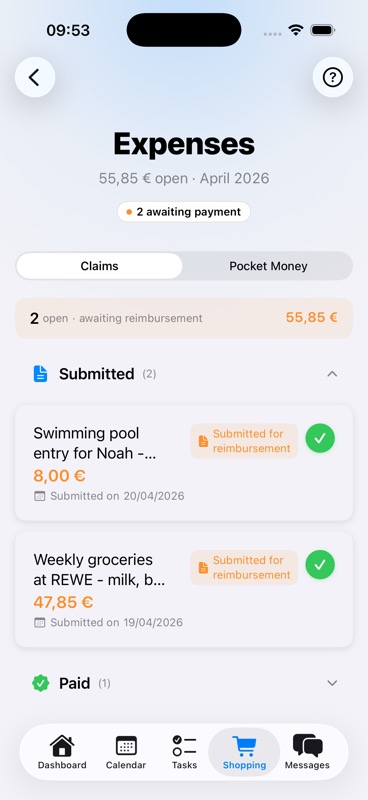
Whatever tool you use, the key is transparency. Set a clear budget from the start, review it together after the first month, and adjust if something isn't working.
Planning Your Budget: A Practical Checklist
Before you commit to hosting an au pair, run through this checklist to make sure your budget is realistic.
- Monthly pocket money amount decided (at least €280, consider your city's cost of living)
- Insurance package selected and quoted (health + accident + liability)
- Language course researched (VHS or private school, cost and schedule confirmed)
- Transit pass cost checked (Deutschlandticket at €49 or city-specific pass)
- Grocery budget adjusted for an additional adult
- Room prepared (furnished, private, with WiFi access)
- One-time costs estimated (welcome package, SIM card, optional bicycle)
- Agency fee paid or independent matching route chosen
- Flight contribution decided and communicated to the au pair
- Emergency buffer set aside (€500 to €1,000 for unexpected costs)
The Real Cost Is an Investment
The numbers in this guide matter — nobody should walk into an au pair arrangement financially unprepared. But the cost conversation misses something important if it stops at euros and cents.
An au pair isn't just childcare measured in hours per euro. It's a young person from another country living in your home, learning your language, becoming part of your family's daily life. Your children grow up hearing another language at the breakfast table. They learn that the world is bigger than their neighbourhood. They form a bond with someone who, in many families, stays in touch for years — sometimes decades — after the au pair year ends.
That's not a line item in a budget. But it's the reason most host families, when asked whether the cost was worth it, don't hesitate for a second.
Planning your au pair budget? Download AuPairSync to keep your expenses, schedules, and family coordination organized from day one.